Developers & investorsEN · NL · DE · ESContact
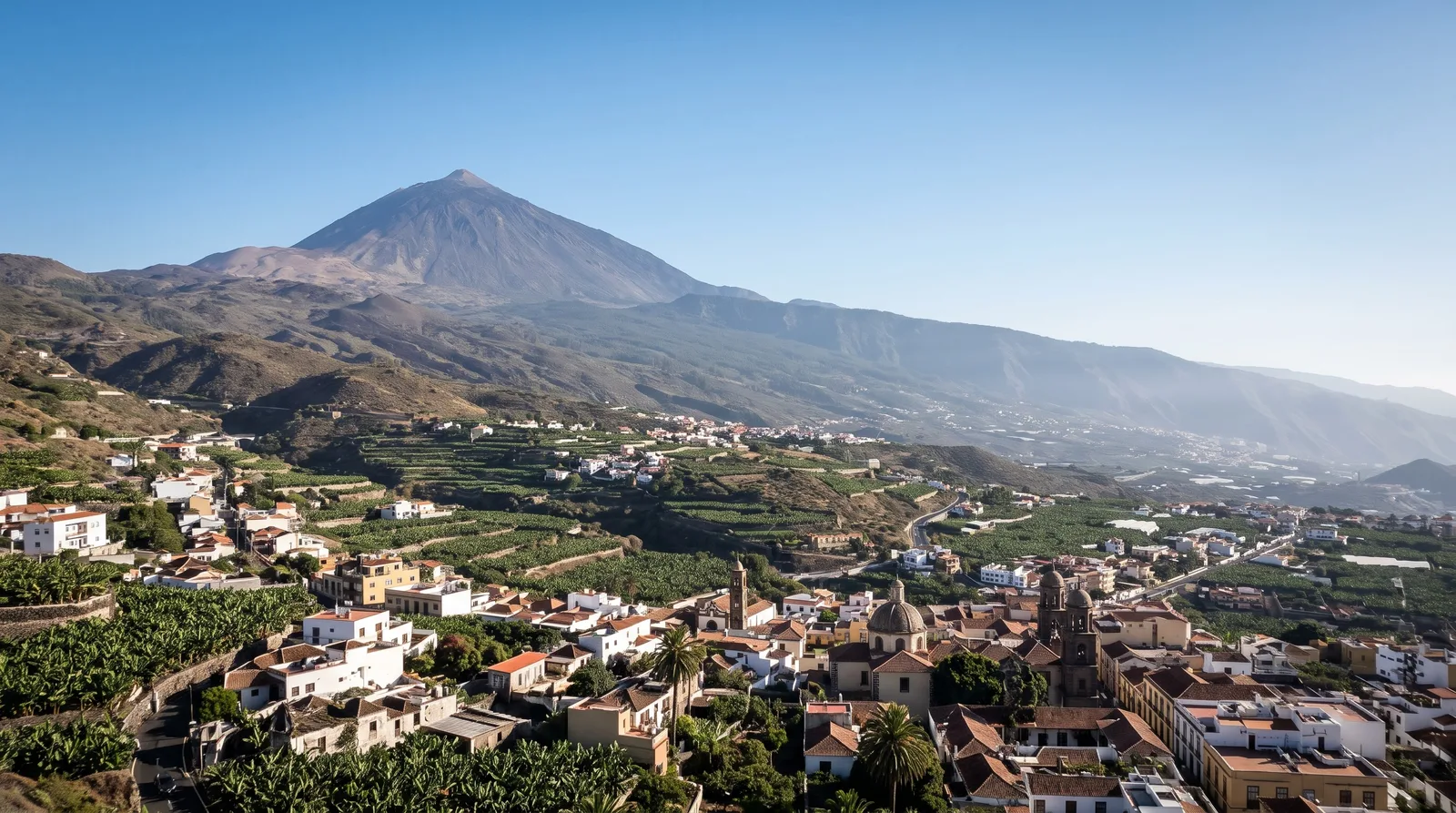
The Orotava valley in Tenerife seen from above: banana terraces, white houses and church domes of the old town, with snow-free Teide volcano rising behind in clear morning light.
Home · Areas

LaOrotava

A historic town of carved wooden balconies and cobbled streets, in a green valley that runs from the sea up to Teide.

Part of the islandNorth coast
Homes for sale with us2
Asking prices€690.000 – €895.000
TownsLa Orotava

Town guide

La Orotava

Population
42,514 in 2025 (+2.9% since 2015)
Tenerife North airport
29 km, 25 min
Tenerife South airport
95 km, 80 min
La Villa shopping centre
4 km, 7 min
Santa Cruz
36 km, 30 min
Supermarkets include
Mercadona, Alcampo, SuperDino, Spar, Altesa, Unide
Homes for sale
153, with a typical asking price of €535,000

The place. One of the finest historic towns in the Canaries, with carved balconies, courtyards and steep streets. It is a separate market from Puerto, a few minutes away. The town runs from the coast at El Bollullo beach up past the valley's banana and vine terraces, through the old centre, to Aguamansa and the road to Teide. La Villa shopping centre and the main British school are close by.

What's for sale. Several markets in one. The old centre and the upper valley are affordable by the standards of the north. El Durazno, next to Puerto's Botánico, and Las Cuevas and Los Gómez are among the most expensive addresses in this guide, with typical asking prices around €770,000.

The historic centre has its own dynamic. Its 641 catalogued buildings are about half empty, and much of the stock needs major work. Move-in-ready homes in the centre are scarce, so they stand apart from the rest of the market.

Homes for sale, 1 November 2026

TypeHomesTypical asking priceMiddle halfTypical sizeAsking per m²
Flats39€235,000€198,000 to €430,000110 m²€2,470
Town houses22€370,000€334,000 to €449,000224 m²€1,550
Semi-detached9€299,000€260,000 to €375,000223 m²€1,100
Detached houses83€790,000€545,000 to €1.20m280 m²€2,710

Where prices differ

NeighbourhoodHomesTypical asking priceAsking per m²
Historic centre and surrounds75€360,000€1,850
El Durazno22€778,000€4,840
La Perdoma / San Antonio / Benijos21€450,000€2,640
Las Cuevas / Los Gómez18€770,000€3,230
El Bebedero / Pinolere / Aguamansa14€300,000€2,030

Recorded sale prices, last 12 months

TypeSalesAverage priceAverage sizePer m²
Flats137€168,000101 m²€1,660
Houses111€287,000207 m²€1,390

Market movement. Of 167 homes listed on 16 September, 20% had left the portal by 1 November and 12% had cut their price (typically by 5.0%). Another 40 new listings were still for sale on 1 November.

Portal price index. The portal's own index for the town was +10.2% over the year to May 2026, at about €2,080 per m². This is an index of what sellers ask, and it swings in small markets.

Who it suits. Buyers who want a real town with history and a strong local life, families using the valley's schools, and people restoring a historic house with their eyes open.

Check before buying.

  • Historic centre: works fall under the town's protection plan, so budget for slower permits and higher costs, and have the structure inspected.
  • Official records often list old houses as built in 1900, which only means "old". The real date can be much earlier, so do not read condition from that record.
  • Altitude changes the weather quickly, and the ravines need checking in heavy rain.

Building here

How long the licence takes

If you want to build or renovate, this is the biggest variable, and it depends almost entirely on the town hall. These are our estimates, not measurements.

Building on Tenerife →
TownTypical caseHard case
La Orotava12–24 months24–36+ months

Selling

Do you own a home in La Orotava?

We tell you what it is worth based on recent sales nearby, not on what others are asking. Within 48 hours, and without obligation.

What is my home worth? →
How to read the numbers
  • Homes for sale is what we counted on the main property portal on 1 November 2026. A home listed twice at the same size and price counts once.
  • Typical asking price is the middle listing: half ask more, half ask less. The middle-half range cuts off the cheapest and dearest quarters.
  • Recorded sale prices come from Spain's notaries: an average over the 12 months up to about late summer 2026. Notaries see every sale, including older homes that never reach the portals, and very expensive sales are underweighted. So the gap between sale and asking figures is not the discount a buyer should expect. It mostly shows that the two sets contain different homes.
  • Market movement runs from the first week we had a complete count of the town. A home that left the portal may have sold, or the owner may have withdrawn it. Eight towns have about six weeks of history; nine have under three, which is too short to read anything into.
  • Drive times are calculated routes in free-flowing traffic. Allow more at rush hour, especially on the TF-5.
  • Rents are asking rents, shown only where at least 10 flats were listed.
What applies in every town

Holiday lets. The Canary Islands law of December 2025 (Law 6/2025) changed the sums for anyone buying for holiday income. Do not assume a home can be let to tourists because the seller does it today.

  • A new holiday let on residential land needs a home at least 10 years old, unless the town's plan lowers that.
  • Where a town has no specific plan, holiday-let beds are capped at 10% of the residents in each population centre and each census section. Detached homes are allowed in principle. Rural settlements have their own density limits. Municipalities classed as facing depopulation get softer limits (five years and 20%).
  • A building's statutes or its owners' vote can rule it out.
  • New permissions last five years and then need renewing.
  • Holiday lets already registered have transition rules: owners who run their own can apply to keep the use within five years, and others have five years, extendable to ten at most in specific cases.
  • A declared stressed housing zone suspends new holiday lets automatically.

Each town is still working out its own plan, so ask the town hall about the specific address.

Near the sea. Spain's Coastal Law restricts building and renovation in a strip behind the shoreline, generally 100 metres and 20 metres in some older urban areas. Check before buying anything close to the water.

Rural land. The north has many houses on farm terraces. What you may build, extend or legalise depends on how the land is classed, so check with the town's planning office before you rely on any extension or plot potential.

Weather. The north coast is greener, cloudier and more humid than the south, and mild all year. Altitude matters more than the map suggests: a few hundred metres uphill can mean more cloud and cooler evenings. Damp is a real point to check in older houses.

Sources

Market figures: our own weekly count of the main property portal (asking prices, to 1 November 2026) and Spain's notaries' published sale prices. Population: Spain's national statistics office, INE, 2015 and 2025. Drive times: calculated with OSRM on OpenStreetMap roads. Supermarkets and pharmacies: OpenStreetMap, which may miss some shops. Links in the text point to the source for each local fact.